
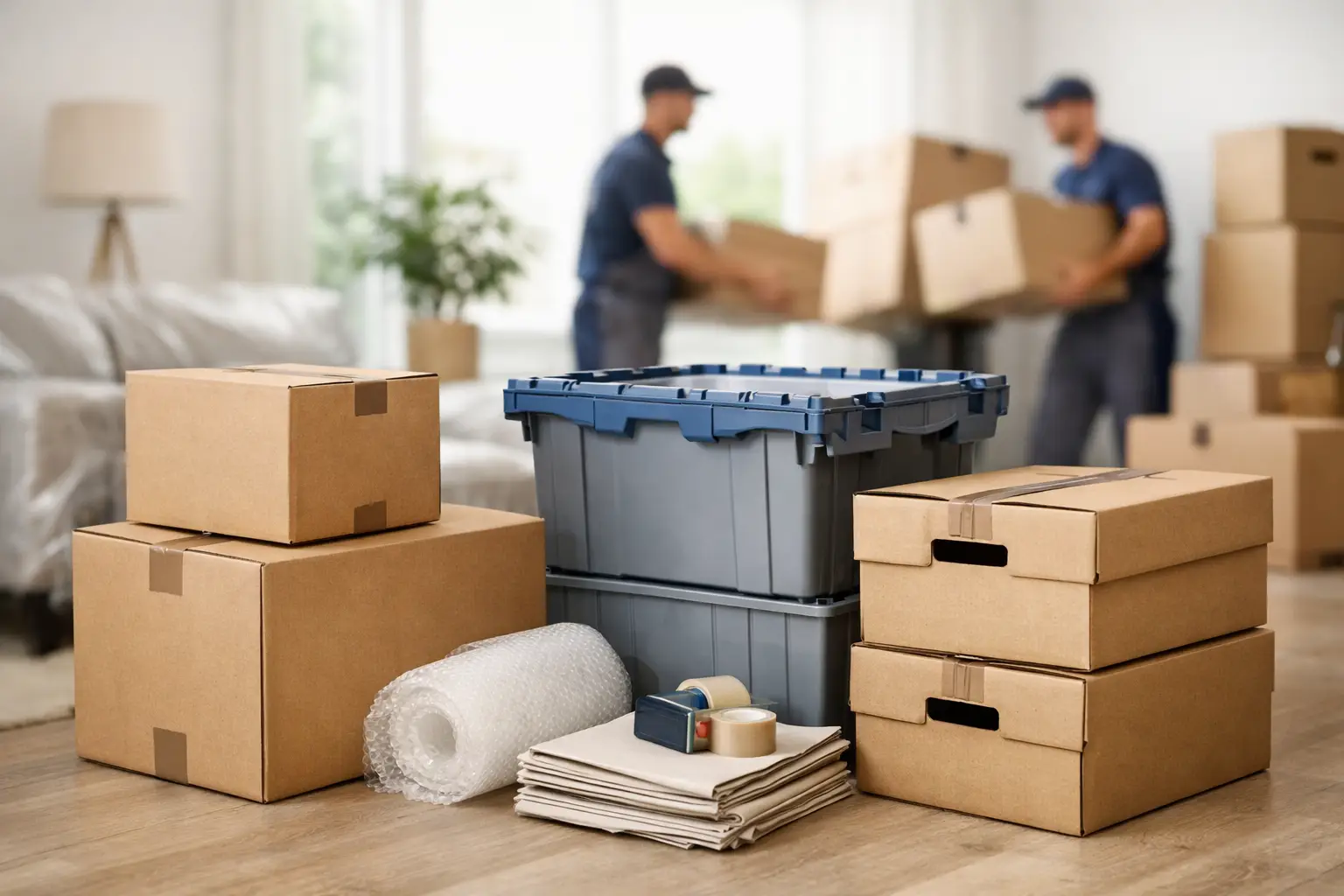
A move can go wrong before the van arrives. A split box, an overfilled carton or a bin bag full of books creates extra lifting, damage risks and delays on moving day. Choosing the best moving boxes for house removals is less about buying the largest bundle available and more about matching each box to what it needs to carry.
For most London moves, strong double-walled cardboard boxes in a small range of useful sizes are the practical choice. They stack safely in a Luton van, protect belongings better than loose bags and make unloading much quicker. The right mix also helps your removal team load efficiently, keeping heavier cartons low and fragile items secure.
What makes a moving box suitable?
A good removal box should hold its shape when lifted, close properly at the top and stack without crushing the box below. Thin supermarket or delivery boxes can be useful for very light items, but they are not always made to carry weight repeatedly. Their handles can tear, their bases can give way and their mixed sizes waste valuable space in the van.
Look for clean, dry cardboard with strong seams. Double-walled boxes are generally the best option for a full house removal because they offer better protection and are more reliable when stacked. Single-walled cartons can still work for linen, cushions and other light belongings, provided they are not overloaded.
Uniform box sizes matter more than many people expect. When cartons are broadly the same width and depth, they can be loaded tightly and safely. This reduces movement in transit and gives the team a clearer, faster loading plan.
New boxes versus used boxes
Used boxes can reduce costs, especially if you are moving a small flat or have plenty of light items. Only use them if they are dry, clean, uncrushed and free from old labels that could cause confusion. Reinforce the bottom with quality packing tape before filling them.
New removal boxes are the safer choice for valuable possessions, books, kitchenware, electronics and longer-distance moves. They are predictable in strength, easier to label and less likely to fail while being carried down stairs or through narrow hallways. If your move involves storage, new double-walled cartons are particularly worthwhile because boxes may be stacked for weeks or months.
The best moving boxes for house removals by size
There is no single box size that works for every room. Large boxes seem economical, but they quickly become too heavy when filled with books, plates or tools. Smaller cartons require more boxes, yet they are easier to lift safely and less likely to burst. A balanced selection is the sensible approach.
Small boxes for heavy items
Small, sturdy boxes are best for books, records, tins, paperwork, tools, toiletries and heavier kitchen items. Their limited capacity stops you from creating a carton that no one can lift safely.
Keep each box manageable rather than trying to fill every available centimetre. A box of books should be heavy enough to be efficient, but not so heavy that it strains the person carrying it or puts pressure on the base. Fill remaining gaps with soft items such as tea towels or packing paper, then tape the box securely.
Medium boxes for everyday belongings
Medium cartons are usually the most useful boxes in a house move. Use them for clothes, toys, shoes, small appliances, folded bedding, kitchen plastics and general household items. They provide enough space to make packing worthwhile without encouraging overfilling.
If you are unsure how many boxes to buy, prioritise medium double-walled cartons, then add small boxes for dense items and a limited number of large boxes for lightweight contents. This gives you flexibility as you work through each room.
Large boxes for light, bulky items
Large boxes are ideal for duvets, pillows, towels, cushions, lampshades, soft toys and winter coats. They are not designed for books, glassware or piles of heavy crockery.
A useful rule is simple: the larger the box, the lighter the contents should be. This protects both your belongings and the people handling them. It also prevents a large carton from becoming awkward to manoeuvre through a doorway, staircase or lift.
Specialist cartons that save time and prevent damage
Standard boxes cover most of a home, but some items need a more specific solution. Specialist cartons cost more than basic boxes, so use them where they solve a genuine packing problem rather than buying them for everything.
Wardrobe boxes are useful when you need to move hanging clothes without folding them into bags or suitcases. They include a rail, allowing clothes to stay on hangers from one wardrobe to another. They are especially helpful for suits, dresses and delicate garments, though they take up more room than ordinary boxes and should not be packed with shoes or other weighty items.
Book boxes are compact and strong, making them suitable for dense contents. Archive boxes with lids can be useful for documents, but ensure they are taped if they will travel in a van or be placed in storage.
For mirrors, framed pictures and televisions, purpose-made picture cartons and TV boxes provide much better protection than trying to adapt a large standard box. Use corner protectors and bubble wrap where needed. If an item is particularly valuable or unusually shaped, professional packing may be safer than relying on a box alone.
Dish packs are reinforced cartons designed for plates, glasses and fragile kitchenware. They work best when every item is individually wrapped, placed upright where appropriate and cushioned so nothing can knock together. A strong box does not replace careful wrapping.
How to pack boxes so they travel safely
The box itself is only half the job. Poor packing can damage items even inside the strongest carton. Start by taping the base with several strips of proper packing tape, including one strip across the central seam and two across the width. For heavier cartons, reinforce the base again in the opposite direction.
Place heavier objects at the bottom and lighter items on top. Fill empty spaces with packing paper, towels or soft clothing so the contents cannot shift. Avoid newspaper for delicate surfaces, as print can transfer onto glass, ceramics or pale fabrics.
Do not make boxes too heavy simply because there is room left. The top should close flat without bulging. A box that cannot close properly is harder to stack, more likely to catch during lifting and less protected from dust or moisture.
Label every box on at least two sides. Write the destination room, a short description of the contents and clear handling instructions where necessary, such as “Fragile” or “This Way Up”. Labels should help the removal team place boxes correctly, but fragile items should still be packed to withstand normal careful handling.
How many moving boxes do you need?
The number depends on how long you have lived in the property, how much storage you use and how much furniture needs dismantling. A furnished one-bedroom flat may need roughly 20 to 35 boxes, while a family home can require 60 or more. These are starting points, not fixed rules.
Before ordering, walk through each room and include cupboards, loft space, under-bed storage and sheds. Kitchens, book collections and children’s rooms often contain more packable items than expected. It is usually better to have a few spare boxes than to pack the final items into weak bags on moving morning.
If you are using a removal service, ask for advice based on your property size and inventory. A practical assessment can identify whether you need additional packing materials, wardrobe cartons, dismantling support or help with fragile items. This can avoid last-minute purchases and make the removal day easier to manage.
Avoid these common box-packing mistakes
The most frequent mistake is mixing heavy and fragile items without enough cushioning. For example, placing a cast-iron pan above wine glasses may save space, but it creates an obvious risk in transit. Keep dense items separate and use small cartons for them.
Another issue is relying on rubbish bags for anything other than soft, non-breakable textiles. Bags tear easily, offer almost no protection and cannot be stacked well in a van. They also make it harder to identify what belongs in each room.
Finally, do not leave boxes unlabelled until the end. By then, many cartons look identical and unpacking becomes slower than it needs to be. Labelling as you pack takes seconds and gives everyone clearer instructions on the day.
For a smoother removal, focus first on strong medium and small cartons, add large boxes only for lightweight belongings, and use specialist boxes where they genuinely protect valuable items. If packing feels like one task too many, The Kings Removals can provide practical packing support alongside the move, so your belongings are protected from the first box to the final unload.