
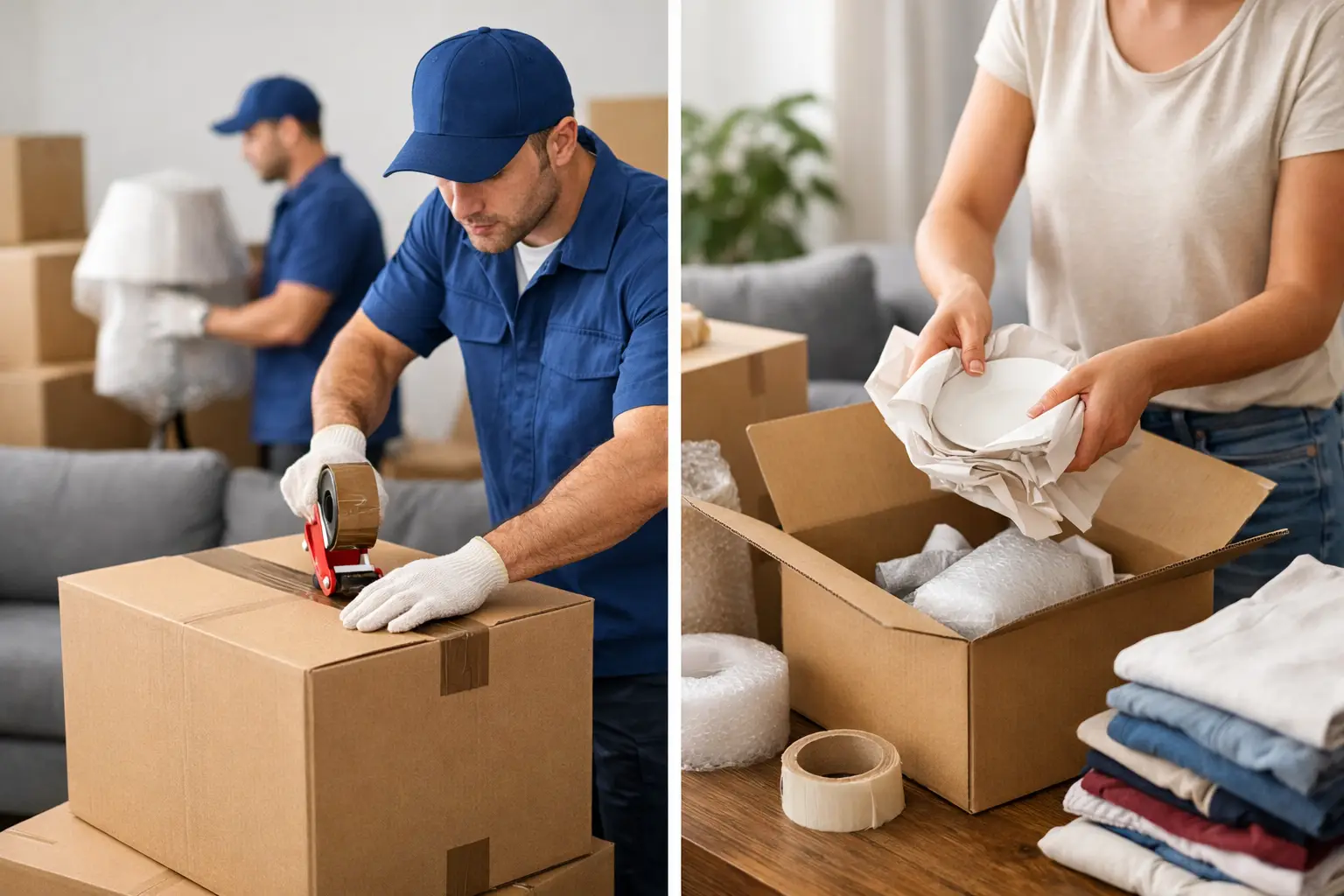
You usually feel the difference between a smooth move and a chaotic one before the van even arrives. It starts with the packing. When people compare packing service versus self packing, they are often really asking four practical questions: How much will it cost, how long will it take, how safe will my items be, and how much stress am I taking on myself?
The right answer depends on your property, your schedule and how confident you are packing everything from plates to wardrobes. For some moves, packing yourself is perfectly reasonable. For others, paying for professional help saves more money, time and hassle than people expect.
Packing service versus self packing: what changes in practice?
On paper, the difference looks simple. With self packing, you source the boxes, wrap your belongings and decide how to label everything. With a packing service, a trained team handles the materials, protects the items properly and packs the home in a more structured way.
In practice, the gap is bigger than that. Professional packers work with speed because they do it every day. They know how to protect fragile kitchenware, how to box books without making cartons too heavy, and how to secure awkward items so they travel safely. Self packing can still work well, but it usually takes longer and leaves more room for rushed decisions the night before moving day.
That matters if you are moving out of a rented flat on a deadline, coordinating keys with an estate agent, or trying to relocate a small office without losing a full working day.
Cost is not just the packing fee
A lot of customers start with the same assumption: self packing is always cheaper. Sometimes it is. If you have a small property, plenty of spare time and only a modest amount of fragile or valuable belongings, doing it yourself can reduce upfront spend.
But packing costs are wider than the price of boxes and tape. You also need to factor in the value of your time, the chance of breakages, and whether slow packing makes the move itself take longer. If movers arrive and everything is still half sorted, the hourly cost of the move can increase quickly.
There is also the question of buying the right materials. People often underestimate how many strong boxes, wardrobe cartons, bubble wrap, packing paper and tape they actually need. Then they either overbuy or run short. Neither helps the budget.
A packing service has a clearer operational benefit. The materials are matched to the job, the packing is done efficiently and the move tends to run to plan. If your priority is keeping the day controlled and avoiding delays, that has real value.
Time pressure usually decides the issue
Time is where packing service versus self packing becomes less theoretical. A one-bedroom flat can still take far longer to pack than expected, especially if you are working full time, managing children, or sorting storage at the same time.
Most people do not pack in one calm, organised session. They do it in stages, late in the evening, while still living in the property. That often leads to half-labelled boxes, mixed contents and last-minute bags full of essentials that should have been packed more carefully.
Professional packing compresses that workload. A team can often prepare in hours what might take a household several evenings or a whole weekend. That is particularly useful if exchange and completion dates shift, your landlord needs the property cleared quickly, or you are moving a business where downtime costs more than the packing itself.
If your move has a fixed deadline, buying time can be more sensible than saving every possible pound.
Risk and damage are where quality matters most
Packing is not only about getting items into boxes. It is about how those boxes perform when lifted, stacked, loaded and unloaded. That is why poor packing often causes problems before the journey has even started.
Overfilled boxes split. Underfilled boxes collapse. Glass packed with clothes instead of proper paper knocks together and chips. Cables go missing because they were thrown into random cartons. Furniture gets scratched because the focus was on the small items and not the larger pieces.
A professional packing service reduces those risks through method rather than luck. Fragile items are wrapped correctly, weights are balanced, labels are clearer and the contents are easier to handle on moving day. If you have mirrors, artwork, electronics, crockery, or furniture that needs dismantling and reassembly, the benefit is even more obvious.
That does not mean self packing guarantees damage. It means the margin for error is smaller when you do it yourself, especially under pressure.
When self packing makes sense
Self packing is a sensible option in the right circumstances. If you are moving from a small flat, have a straightforward inventory and can start early, doing it yourself may be the best fit. It also suits people who prefer complete control over how personal items are sorted.
Some customers want to pack documents, jewellery, sentimental items or collections themselves and that is completely reasonable. Others simply have enough time and want to keep the move as lean as possible.
If you choose this route, the key is to treat packing as part of the move itself, not as something to squeeze in around everything else. Start earlier than you think you need to. Use strong boxes. Label by room and contents. Keep heavy items in small cartons and lighter items in larger ones. Pack an essentials box separately so you are not opening ten cartons looking for the kettle or mobile phone charger.
Self packing works best when it is planned, not improvised.
When a packing service is worth paying for
There are moves where professional packing is not an extra – it is the practical way to keep the job manageable. Larger family homes are an obvious example, but not the only one.
It is often worth paying for a packing service if you are short on time, moving with children, handling a probate property, downsizing, relocating an office, or transporting fragile and valuable items. The same applies if access is awkward, the move involves storage, or you need furniture dismantled and rebuilt as part of the day.
In those situations, packing is closely linked to loading efficiency and item protection. The better the preparation, the smoother the whole removal tends to be. That is one reason many customers use a removal company for both packing and transport rather than splitting responsibility across different parts of the job.
A provider such as The Kings Removals can also adapt the level of help. Some customers want a full packing service. Others only need help with the kitchen, breakables or bulky furniture. That flexibility is often more cost-effective than people expect.
A hybrid approach is often the best answer
This is the option many people overlook. Packing service versus self packing does not always have to be one or the other.
A hybrid move can give you better control over cost without leaving you overwhelmed. You might pack clothes, books and non-fragile items yourself, then use professionals for the kitchen, glassware, artwork, TVs and furniture protection. You still reduce labour time, but you get expert help where mistakes are most expensive.
For business moves, the same logic applies. Staff can box personal desk items and files, while a removals team handles equipment, monitors, chairs and secure transport planning. That split keeps the job efficient without overcomplicating it.
If you are unsure, this is often the most practical middle ground.
How to decide between packing service versus self packing
A simple way to judge it is to ask yourself three things. First, do you realistically have the time to pack properly before moving day? Second, would the cost of damage, delays or extra moving hours outweigh the saving? Third, are there items in your home or business that really need experienced handling?
If your answers point towards pressure, risk or complexity, a packing service is usually the safer decision. If your move is small, low-risk and well planned, self packing may be enough.
The best choice is not the one that sounds cheapest at first glance. It is the one that keeps the move controlled from start to finish, protects your belongings and fits the way your week actually looks.
A move is hard enough without turning packing into a last-minute problem. Choose the option that gives you the best chance of arriving with everything in the right place, in the right condition, and without unnecessary stress.